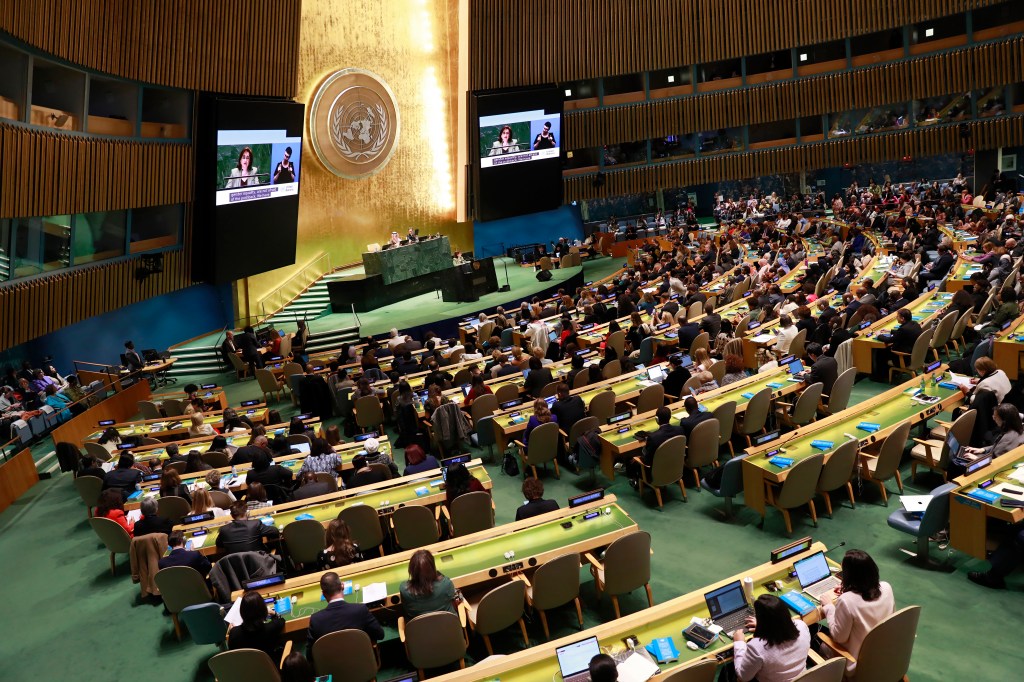
If you’ve ever wondered what it looks like when the global patriarchy tries to agree on what to do to accelerate progress on “gender equality,” look no further than CSW69. No, not that kind of 69 (haha!)… We’re talking about the 69th session of the Commission on the Status of Women, an annual exercise in multilateral multitasking, where Member States, civil society, and the entire alphabet soup of UN acronyms gather to assess progress, challenges, and the future of women’s and girls’ rights.
Welcome to Beijing+30: It’s Giving… Retrospective Realness
This year wasn’t just any CSW. It was Beijing+30, marking three whole decades since the legendary 1995 Fourth World Conference on Women that adopted the Beijing Declaration and Platform for Action (aka the Beyoncé album of global gender equality frameworks).
Thirty years later, you’d think we’d be throwing confetti and passing binding resolutions left and right. But instead? We got… a Political Declaration and a new Multi-Year Programme of Work (MYPoW).
Okay, maybe not the fireworks we dreamed of, but let’s unpack the good, the bad, and the beautifully bureaucratic.
The Political Declaration: Drama in Many Acts and Sub-Paragraphs
The Political Declaration went through more revisions than seasons of Grey’s Anatomy. We had a Zero Draft, then Rev.1, Rev.2, a couple of “on-screen texts” (because nothing says transparency like words projected in a closed door meeting), and finally the Co-Facilitators’ text, aka the “we’re out of time, agree on this” version.
Negotiations lasted over 48 hours over a few weeks. Diplomats ran on coffee, conviction, and pure adrenaline.
Some of the greatest hits from the battlefield of semantics:
- Delete gender, insert euphemism: Terms like “gender equality” and “gender-responsive” were being swapped for 12-word phrases that did backbends to avoid the word “gender” entirely.
- Whether or not to mention adolescent girls: Still controversial to name, still too spicy for consensus.
- Human rights defenders? Silenced. Attempts to reference human rights defenders were consistently shut down, as if their work isn’t foundational to every right being discussed.
- UN Security Council Resolution 1325? CEDAW General Recommendation 40? Ghosted. No explicit references made it in, despite their centrality to global frameworks on women, peace, security, and discrimination.
- Encouraging the nomination of women for UN leadership? Apparently too provocative.
Honestly, it was like watching a game of Jenga where the pieces are made of centuries-old power structures and everyone’s using diplomatic language to pretend they’re not panicking. If you were hoping for ambition, innovation, or a clear stand on structural transformation… You may be waiting another 30 years (gosh, we hope not!).
Intergovernmental Speed Dating (With Less Flirting)
Behind every paragraph is a delicate dance of Member States negotiating in groups and on their own. We saw groups including the:
- African Group
- Caribbean Community (CARICOM)
- European Union (EU)
- Gulf Cooperation Council (GCC)
- Mountains
- Pacific Island Forum (PIF)
- And many more Member States intervening in their national capacities.
Let’s just say, if these negotiations were a reality show, the confessional interviews would be iconic.
Meanwhile, the Multi-Year Programme of Work (MYPoW) Showed Up with a 5-Year Plan
Perhaps overshadowed by the Political Declaration’s drama was the quieter but incredibly important Multi-Year Programme of Work. This is a roadmap for what CSW will focus on from 2026 to 2029.
What’s on the menu then for the next four years?
- 2026 will focus on strengthening access to justice.
- 2027 will focus on gender equality in the context of the 2030 Agenda for Sustainable Development.
- 2028 will focus on strengthening care and support systems.
- 2029 will focus on humanitarian emergencies and advancing women’s participation and leadership.
Basically, it’s the CSW equivalent of having long-term vision. Think of it as CSW’s playlist for the next four years.
Was It Worth It?
Well… it depends on who you ask.
If you expected bold new commitments? You were probably underwhelmed.
If you were bracing for regression? You might be relieved.
If you sat through those gruelling negotiations and survived the ‘should “gender” even be in the outcomes’ showdown? Honestly, you’re a hero.
Here’s the thing: CSW69 didn’t rewrite the feminist playbook or deliver us a package wrapped in binding commitments, but it did keep the page open. It reaffirmed some fundamentals, pushed forward on backsliding, and crucially, gave us a shared space to continue the fight for rights, equality, and empowerment.
CSW69 was peak multilateralism: messy, maddening, and magnificently stubborn. But it was also proof that people still care enough to show up, debate, and protect spaces for progress.
In a global climate where rights are being eroded faster than you can say “patriarchal pushback,” holding the line is not nothing.
 Intergovernmental Support